
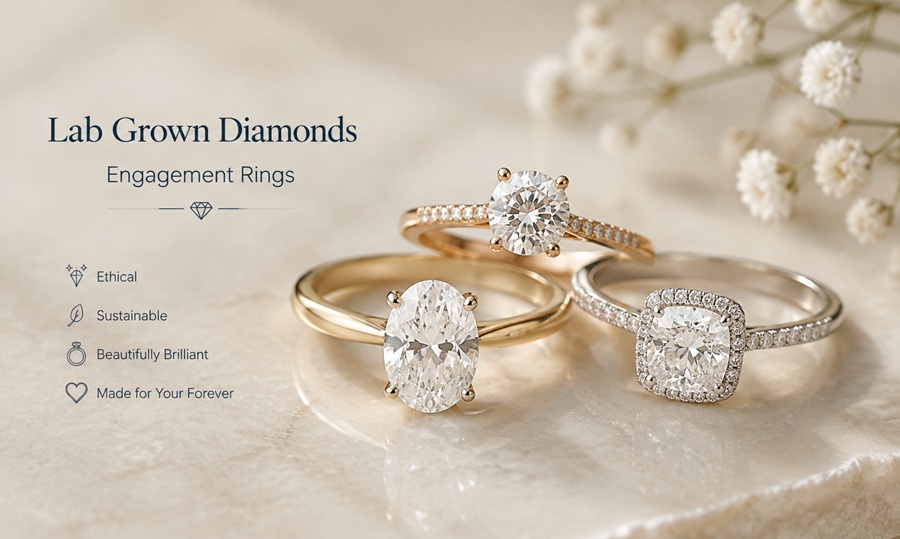
Lab grown diamonds are chemically, physically, and optically identical to mined diamonds — same carbon crystal structure, same sparkle, same hardness. The only real difference is origin: one forms underground over billions of years, the other forms in a lab over a few weeks. For engagement rings, that difference mostly shows up in price.
What a Lab Grown Diamond Actually Is
A lab grown diamond isn’t a fake or a simulant like cubic zirconia or moissanite. It’s real diamond — pure carbon in a crystal lattice — created using one of two processes:
- HPHT (High Pressure High Temperature): replicates the pressure and heat conditions found deep underground
- CVD (Chemical Vapor Deposition): grows diamond layer by layer from carbon-rich gas in a chamber
Under a microscope, a gemologist can tell the two apart using specialized equipment, but to the naked eye — and to standard jewelry grading — they’re indistinguishable in appearance.
Lab Grown vs. Mined: Side-by-Side
| Factor | Lab Grown Diamond | Mined Diamond |
|---|---|---|
| Physical properties | Identical | Identical |
| Price for same size/quality | 40–70% less | Full market price |
| Origin traceability | Fully known | Sometimes murky |
| Resale value | Lower, still developing market | More established, though diamonds generally hold value poorly overall |
| Environmental footprint | Lower | Higher, mining-intensive |
| Rarity/prestige factor | Lower, for now | Higher due to tradition |
Why Couples Are Choosing Lab Grown
The price gap is the biggest driver. A one-carat, high-quality lab grown diamond can run 50–60% less than a comparable mined stone, which means couples can afford a noticeably larger or higher-grade diamond for the same budget.
Beyond cost, some couples are drawn to the environmental and ethical angle — lab diamonds sidestep concerns about mining practices and, in some cases, conflict sourcing, since origin is fully traceable from creation.
Things to Know Before Buying
Certification Still Matters
Always buy a lab grown diamond with certification from a recognized lab (GIA and IGI are the most common), which grades cut, color, clarity, and carat the same way it does for mined stones.
Price Isn’t Static
Lab grown diamond prices have dropped substantially over the past several years as production scaled up, and that trend is expected to continue — worth knowing if resale value factors into your decision.
Resale Is Still a Developing Market
Diamonds in general aren’t strong investment pieces — most lose significant resale value the moment they leave the store. Lab grown diamonds currently resell for even less relative to their purchase price, since the secondary market is still maturing. If resale matters to you, factor that into your decision rather than assuming either type holds value well.
How to Choose Between the Two
Ask yourself a few honest questions:
- Does the “millions of years old” origin story matter to you personally, or is sparkle and size the priority?
- Is stretching your budget for a bigger or higher-grade stone more appealing than the traditional mined option?
- Do environmental or ethical sourcing concerns weigh into your decision?
- Will you (or your partner) care about resale value down the line?
There’s no universally “better” answer — it comes down to what matters most to the two of you.
Buying Tips Regardless of Which You Choose
- Insist on certification from GIA or IGI
- Buy from a retailer with a clear return and resizing policy
- Compare the 4Cs (cut, color, clarity, carat) rather than focusing on carat size alone
- Get independent appraisal for insurance purposes after purchase
FAQ
Are lab grown diamonds “real” diamonds?
Yes. They share the same chemical composition and physical properties as mined diamonds — the difference is purely in how they’re created.
Can jewelers tell the difference without special equipment?
Not with the naked eye. Specialized lab equipment is required to distinguish lab grown from mined diamonds.
Do lab grown diamonds hold their value?
Generally less than mined diamonds on resale, and mined diamonds themselves aren’t strong resale investments either — buy for the ring you want, not as an investment vehicle.
Are lab grown diamonds more ethical?
Generally considered more transparent in sourcing, since their origin is fully traceable, though “ethical” mined diamonds are also available through certified conflict-free channels.
How much cheaper are lab grown diamonds really?
Typically 40–70% less than a comparable mined diamond of the same size and quality grade.
Will a lab grown diamond ring look different in any noticeable way?
No — visually, they’re indistinguishable from mined diamonds to the naked eye.
Lab grown diamonds offer real diamond quality at a meaningfully lower price point, with growing acceptance across the jewelry industry. Whether that’s the right choice comes down to personal priorities — budget, values, or the sentimental pull of a mined stone’s origin story. Either way, focus on certification and cut quality over marketing claims.
