
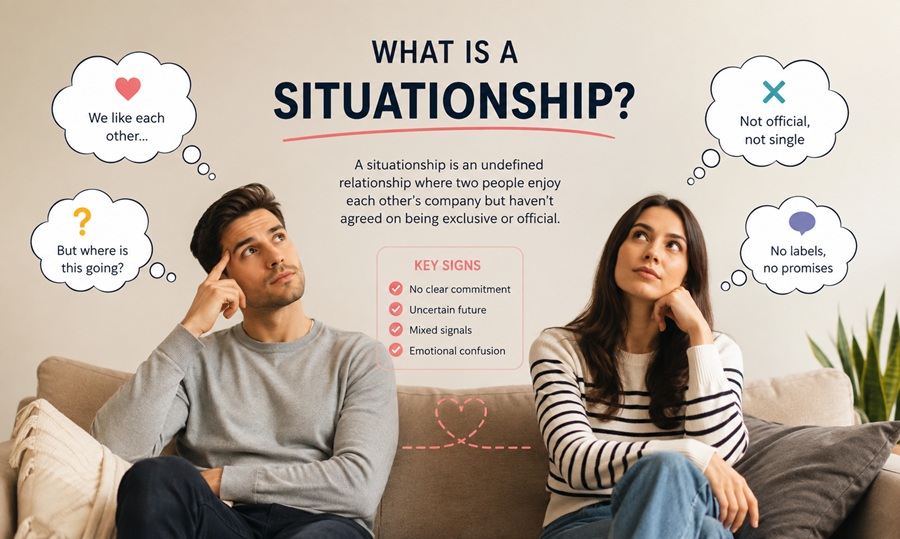
A situationship is a romantic or physical connection between two people that lacks the clear commitment, exclusivity, or defined labels of a traditional relationship. It often includes emotional and physical intimacy similar to dating, but without agreed-upon expectations about the future.
MYTH: A situationship is just casual dating with a trendier name. FACT: A situationship specifically involves relationship-like intimacy — regular contact, emotional closeness, sometimes exclusivity in practice — without either person defining what it actually is. That undefined status is the core feature, not a technicality.
Myth vs. Fact: Understanding Situationships
Myth: Situationships are always temporary and low-stakes
Fact: Situationships can last months or even years, and the emotional investment involved can be just as deep as a defined relationship — sometimes deeper, precisely because there’s no clear structure to fall back on when things get complicated.
Myth: If there’s no label, there are no feelings involved
Fact: The absence of a label doesn’t mean absence of attachment. Many people in situationships develop strong feelings, which is often exactly what makes the lack of clarity so painful.
Myth: Situationships only happen because of dating apps
Fact: While dating apps have popularized the term and made ambiguous dating more common, undefined relationships have existed long before modern dating culture — they just didn’t have a catchy name.
Myth: Both people always want the same thing out of a situationship
Fact: Mismatched expectations are extremely common. One person often hopes it evolves into something more defined, while the other is comfortable with the ambiguity — a gap that frequently causes the eventual breakdown.
Signs You Might Be in a Situationship
- You spend regular time together, but the relationship has never been explicitly defined
- You avoid labels like ‘boyfriend,’ ‘girlfriend,’ or ‘partner’ even though the dynamic resembles one
- Future plans are rarely discussed or are actively avoided
- You’re unsure whether you’re exclusive, and haven’t directly asked
- The relationship exists mostly on the other person’s terms or schedule
- You feel anxious bringing up ‘what are we’ for fear of ending things
Why Situationships Happen
Situationships often form gradually rather than by intention. Two people meet, connection builds naturally, and neither wants to be the one to introduce a ‘define the relationship’ conversation for fear of scaring the other person off. Over time, the relationship-like behaviors continue without the relationship-like commitment ever being formally agreed upon.
For some people, situationships are a genuine preference — a way to enjoy intimacy and companionship without the pressure of long-term commitment during a busy or transitional life stage. For others, it becomes a source of ongoing anxiety, especially when feelings develop faster than clarity does.
Situationship vs. Relationship: Key Differences
| Aspect | Situationship | Committed Relationship |
| Labels | Undefined or avoided | Clearly established |
| Exclusivity | Assumed but rarely confirmed | Explicitly agreed upon |
| Future planning | Rarely discussed | Openly discussed and planned |
| Public acknowledgment | Often kept private or ambiguous | Usually acknowledged to friends and family |
| Emotional security | Often uncertain | Generally more stable |
How to Navigate a Situationship
If you’re in a situationship and want clarity, the most effective path is a direct conversation rather than waiting for the ambiguity to resolve itself. That means naming what you’re noticing (‘we’ve been seeing each other regularly for months, and I’d like to know where you see this going’) rather than hinting or testing the waters indirectly.
| Tip: Before initiating the conversation, get honest with yourself about what outcome you actually want — a defined relationship, exclusivity without labels, or simply clarity either way — so you’re not caught off guard by your own answer. |
The Emotional Toll of Prolonged Ambiguity
Uncertainty is mentally taxing in a way that clear rejection often isn’t. Psychological research on ambiguity consistently shows that unclear situations tend to generate more anxiety and rumination than clearly negative ones, because the brain keeps searching for resolution it can’t find. This is part of why situationships that drag on for months without any conversation can leave someone feeling more anxious and preoccupied than a clean breakup would — there’s no defined ending to process, just an ongoing question mark.
If you notice yourself frequently overanalyzing texts, checking their social media for clues, or feeling a persistent low-grade anxiety about ‘what we are,’ that’s a strong signal the ambiguity has become more costly than the connection is worth, at least in its current undefined form.
Common Reasons People Avoid Defining the Relationship
- Fear that asking for clarity will end the connection entirely
- Genuine uncertainty about their own feelings or readiness for commitment
- Past relationship trauma making labels feel risky or overwhelming
- Enjoying the low-pressure nature of the current dynamic and not wanting to disrupt it
- Assuming the other person feels the same way without ever confirming it
Understanding which of these might be driving your partner’s hesitation — or your own — can shape how you approach the conversation. Someone avoiding labels out of fear responds differently to reassurance than someone avoiding labels because they genuinely don’t want a relationship right now.
Situationships and Social Media
Modern dating culture has added a layer of complexity to situationships that didn’t exist a generation ago: the question of public acknowledgment online. Whether or not to post together, follow each other publicly, or mention the relationship to mutual friends can become its own source of ambiguity and tension, sometimes serving as an unspoken barometer of where things actually stand. Some couples in situationships explicitly avoid these public markers precisely because doing so keeps expectations low and exit costs minimal; noticing this pattern can be a useful, if uncomfortable, clue about how the other person is truly viewing the connection.
How Situationships Differ Across Age Groups
While situationships are often associated with younger daters navigating apps and early adulthood, the dynamic shows up across age groups, just with different underlying causes. Younger daters may gravitate toward undefined connections while prioritizing career building or personal independence. Older daters, particularly those re-entering the dating world after a divorce or long-term relationship, sometimes prefer the reduced pressure of a situationship while rebuilding confidence or figuring out what they actually want next. In both cases, the core feature — intimacy without an agreed-upon label — remains the same, even if the motivations differ significantly.
Is a Situationship Right for You?
Whether a situationship is a good fit depends heavily on self-awareness about what you genuinely want, not just what feels comfortable in the moment. Some people thrive in undefined connections and find the lack of pressure genuinely freeing. Others find that ambiguity gradually erodes their sense of security, even if they initially convinced themselves they were fine with it. Regularly and honestly checking in with yourself about how the arrangement is actually affecting your wellbeing — not just whether you enjoy the person’s company — is the clearest way to know if a situationship is serving you or quietly costing you more than it’s giving.
Frequently Asked Questions
How is a situationship different from friends with benefits?
Friends with benefits typically implies an explicitly casual, low-commitment arrangement both people agree to, while a situationship often carries more emotional ambiguity and relationship-like intimacy without that explicit agreement.
Can a situationship turn into a real relationship?
Yes, situationships can evolve into defined relationships, but it usually requires an explicit conversation rather than assuming the dynamic will naturally shift on its own.
Is it normal to catch feelings in a situationship?
Very normal. Regular emotional and physical intimacy tends to build attachment regardless of whether a label has been assigned to the relationship.
How long do situationships typically last?
There’s no fixed timeline — some resolve within weeks once a conversation happens, while others continue for months or years without either person addressing the ambiguity.
What’s the healthiest way to end a situationship?
Direct, honest communication about your feelings and intentions, ideally in person, tends to lead to a cleaner resolution than gradually pulling away or going silent.
A situationship isn’t inherently bad — for some people, it’s exactly the kind of connection they want at a particular point in life. The trouble tends to start when one person quietly wants more than the arrangement offers. If that sounds like where you are, the discomfort of an honest conversation is almost always less costly than the slow ache of prolonged ambiguity.
