
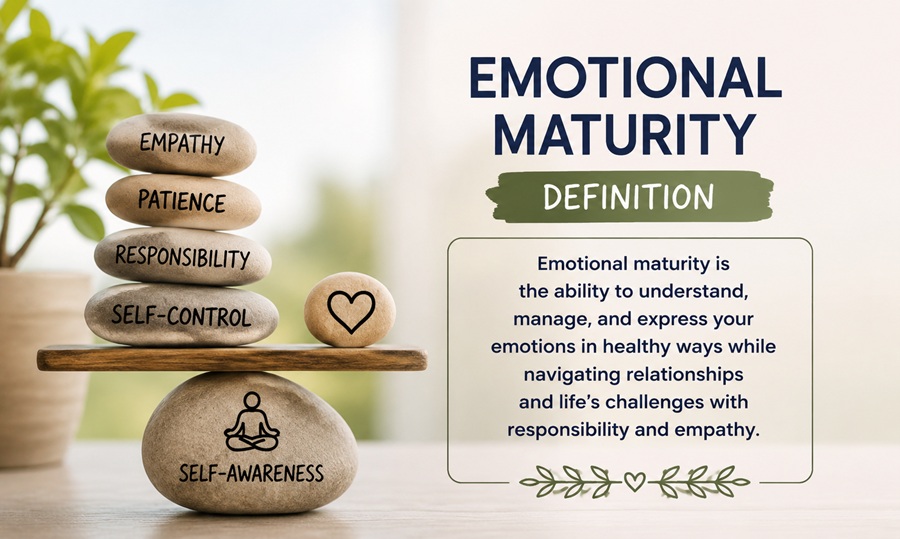
Emotional maturity is the capacity to recognize, understand, and manage your own emotions while also responding thoughtfully to the emotions of others — even under stress. It isn’t about age. Someone can be forty and emotionally reactive, or twenty-two and remarkably composed. It’s a skill set, built through experience and intention.
Defining Emotional Maturity Beyond the Buzzword
The phrase gets thrown around constantly — in relationship advice, in workplace feedback, in therapy sessions. But at its core, emotional maturity comes down to a few measurable behaviors:
- Taking responsibility for your own reactions instead of blaming others
- Tolerating discomfort without immediately needing it to go away
- Communicating needs directly rather than through hints or withdrawal
- Staying regulated during conflict instead of escalating or shutting down
None of these require perfection. Emotionally mature people still get upset, still make mistakes, still have bad days. What separates maturity from immaturity is how quickly someone recovers and how they handle themselves in the meantime.
Where the Concept Comes From
Developmental psychologists have studied emotional growth for decades, and most frameworks agree on one thing: emotional maturity develops in stages, often tied to how well someone’s early emotional needs were met. A person raised in an environment where feelings were dismissed may need to build these skills later in life, deliberately, rather than absorbing them automatically.
This matters because it reframes emotional maturity as something learnable — not a fixed trait you either have or don’t.
Signs of Emotional Maturity
In How Someone Handles Conflict
- They can disagree without needing to “win”
- They separate the issue from the person
- They’re willing to say “I was wrong” without spiraling into shame
In How Someone Handles Their Own Emotions
- They notice a feeling before it turns into a reaction
- They can sit with sadness, anger, or anxiety without needing an immediate outlet
- They don’t require constant reassurance to feel secure
In How Someone Treats Others
- They listen to understand, not just to respond
- They respect boundaries even when it’s inconvenient
- They can hold space for someone else’s bad day without making it about them
Emotional Maturity vs. Emotional Immaturity
| Situation | Emotionally Mature Response | Emotionally Immature Response |
|---|---|---|
| Receiving criticism | Considers it, asks clarifying questions | Gets defensive, deflects blame |
| Partner cancels plans | Expresses disappointment calmly | Sulks or gives silent treatment |
| Making a mistake at work | Owns it, proposes a fix | Blames circumstances or others |
| Disagreement with a friend | Discusses it directly | Vents to others instead of addressing it |
| Feeling jealous | Names the feeling, examines why | Acts out or becomes controlling |
How Emotional Maturity Develops Over Time
- Self-awareness comes first. You can’t manage what you don’t notice. Naming emotions as they happen — even just internally — is the starting point.
- Tolerance for discomfort builds next. Learning to sit with an uncomfortable feeling without immediately reacting is a trainable skill, often developed through therapy, mindfulness, or simply repeated practice.
- Perspective-taking follows. Understanding that other people’s reactions are shaped by their own history, not solely by you, reduces defensiveness.
- Accountability solidifies it. Owning mistakes without collapsing into shame is often the last piece to click into place.
This isn’t a linear ladder everyone climbs at the same pace. People often develop maturity unevenly — highly composed at work, reactive at home, or vice versa.
Practical Ways to Build Emotional Maturity
- Pause before responding when you feel a strong reaction rising — even five seconds helps
- Practice naming your emotion specifically (“frustrated” instead of just “bad”)
- Ask yourself what you actually need in a moment of conflict, rather than what you want to say
- Notice patterns: do you shut down, lash out, or seek reassurance when upset? Awareness of the pattern is the first step to changing it
- Seek feedback from people you trust about how you come across under stress
Why This Matters for Relationships
Emotional maturity is one of the strongest predictors of relationship stability — arguably more than compatibility of interests or values. Two people who disagree on politics but handle conflict maturely will often outlast two people who agree on everything but escalate every disagreement into a crisis.
It also shows up outside romance — in friendships, family dynamics, and workplaces, where the ability to stay steady under pressure consistently earns trust.
Frequently Asked Questions
Is emotional maturity the same as emotional intelligence?
They’re related but not identical. Emotional intelligence is broader, covering the ability to perceive and use emotional information generally. Emotional maturity refers more specifically to how well-regulated and accountable someone is in practice.
Can someone become more emotionally mature later in life?
Yes. It’s a developed skill, not a fixed trait, and many people build significant emotional maturity in their thirties, forties, or beyond, often through therapy or major life experiences.
Does emotional maturity mean never getting upset?
No. It means recovering from being upset without letting it dictate destructive behavior.
How can I tell if I’m emotionally immature?
Common signs include frequent defensiveness, difficulty apologizing sincerely, and a pattern of blaming others for how you feel.
Is emotional maturity linked to age?
Loosely, but not reliably. Life experience can build it, but plenty of older adults remain emotionally reactive while some younger people show strong emotional regulation.
Final Thought
Emotional maturity isn’t about suppressing feelings or appearing endlessly calm — it’s about having a working relationship with your own emotional life, one where you can feel things fully without letting them run the show. That’s a skill worth building deliberately, at any age.
